
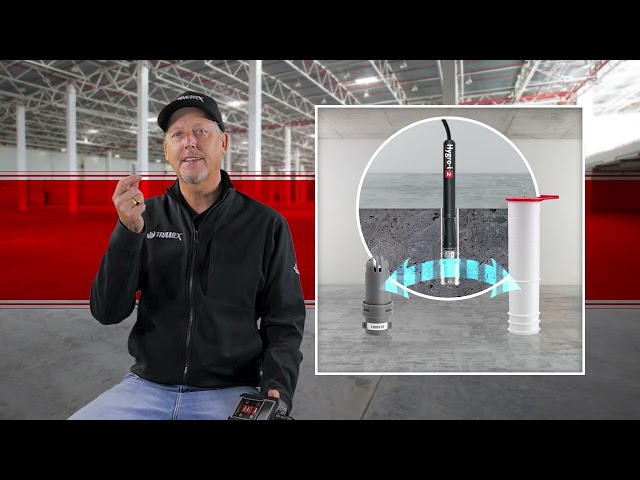
In the world of concrete testing, accuracy is everything—especially when it comes to measuring relative humidity (RH) in concrete slabs. Whether you are a flooring installer, inspector, or concrete professional, understanding the proper procedures for ASTM F2170 testing can make all the difference in avoiding costly errors. In this blog and video, we will dive into why waiting 24 hours after drilling is crucial for reliable results, and how tools like the Tramex Hygro-i2 reusable RH probes ensure compliance and precision.
What is ASTM F2170 testing? The basics
ASTM F2170 is the standard test method for determining the relative humidity percentage within a concrete floor slab. The procedure is straightforward but requires careful attention to detail:
- Drill a hole in the concrete slab.
- Insert a hole liner into the drilled hole.
- Cap the liner.
- Wait 24 hours before inserting the RH probe (as per ASTM F2170,10.3 & 10.5) to make relative humidity measurements.
This waiting period isn't arbitrary—it's essential for obtaining accurate readings. Skipping it can lead to significant errors in your measurements.
Why does the 24-hour wait matter for RH probes?
Drilling into concrete generates heat, which attracts vapor moisture to the hole. If you insert the RH probe immediately after drilling, this excess moisture can cause a false positive reading. In other words, you can get an inflated RH value that may not reflect the true conditions inside the slab.
All RH probes contain sensors, and manufacturers note that exposure to high relative humidity conditions can cause the readings to "creep" over time. That's why ASTM F2170 specifically requires inserting the probe only after the 24-hour wait—to avoid these false readings triggered by drilling heat.
What are the benefits of Tramex Hygro-i2 reusable RH probes?
The Tramex Hygro-i2 probes are designed with ASTM F2170 compliance in mind. Unlike some probes that are attached to the hole liner, the Hygro-i2 is separate, allowing you to follow the standard procedure exactly: insert the liner, cap it, wait 24 hours, and then add the probe.
These reusable probes not only provide accurate readings but also offer cost savings over disposable options. Plus, you can verify their calibration anytime using the Tramex Calibration Salt Check. For added documentation and peace of mind, use the Tramex Meters App to geotag and record your calibration checks and readings.
How to get the full moisture picture beyond RH testing
While the in-situ RH test gives a clear indication of vapor moisture within the slab, it's important to remember that it doesn't tell the whole story. You also need to assess liquid moisture, or the percentage moisture content (%MC), both on the surface and in-situ. This can be done with a calibrated concrete moisture meter, such as the Tramex Moisture Encounters CME5 and CMEX5. In-situ moisture content measurements are carried out with the Tramex Concrete Moisture Probe, the Determinator.
To get a comprehensive understanding of a concrete slab's moisture conditions, follow the Tramex Complete Concrete Moisture Test System, also known as the 5-Point Test. This approach combines RH testing with %MC measurements for the most reliable evaluation.
This article is presented by Tramex, a global leader in moisture and humidity measurement for more than 50 years. Our engineers and industry specialists work alongside professionals in building inspection, flooring, roofing and water damage restoration to provide accurate and reliable information. With decades of experience and innovation in non-destructive moisture detection, we share practical insights backed by science and real-world experience.